John Fryer (1650–1733) was an English physician and traveler who, unlike many of his contemporaries, brought a scientific and professional perspective to his travel writing. His work, A New Account of India and Persia, provides a unique blend of medical, commercial, and ethnographic observations.
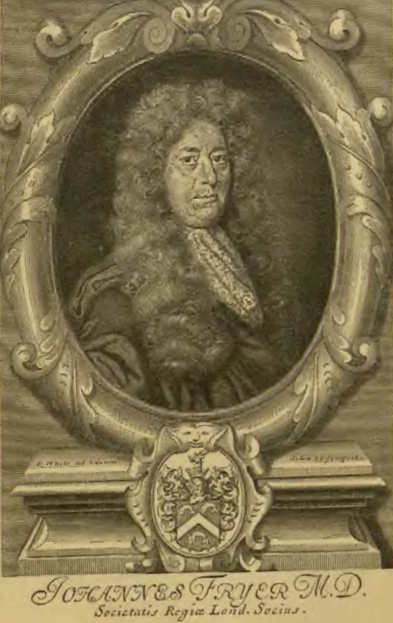
Life and Mission
Fryer’s journey to India began in 1672 when he was employed as a surgeon for the English East India Company. This professional role shaped his entire account, as he was uniquely positioned to observe and document the natural world, the diseases afflicting travelers, and the medical practices of the local populations. His voyage was part of a larger fleet, which he meticulously described, noting the military tensions with the Dutch.
Impact and Legacy
Fryer’s travelogue stands out for its scientific and intellectual curiosity. It is not just a commercial or diplomatic report but a proto-scientific inquiry into the geography, botany, and health of the regions he visited. He provided detailed descriptions of local flora and fauna, such as the coconut tree and the behavior of sharks, and offered practical medical advice for other travelers. His observations on the “Epidemical Distemper” (likely scurvy) and its cure with citrus fruits were particularly valuable.
His account is a testament to the growing interest in systematic, empirical observation in late 17th-century Europe. Fryer’s work helped to move travel writing beyond simple adventure narratives, positioning it as a tool for scientific and cultural documentation. It is a crucial source for historians interested in the early modern intersection of medicine, commerce, and exploration.