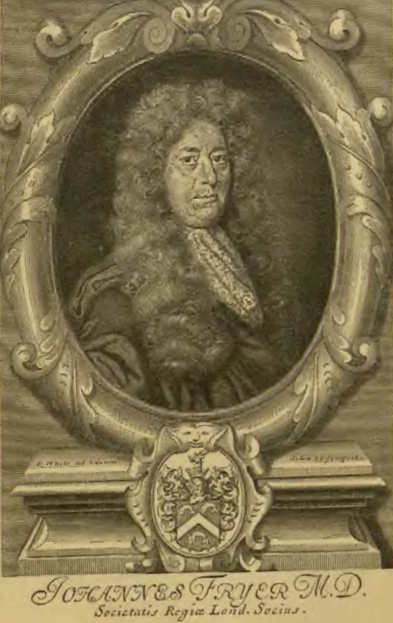
John Fryer’s A New Account of India and Persia occupies a distinctive position within the corpus of seventeenth-century travel writings. Unlike the diplomatic account of Roe or the commercial log of Mundy, Fryer writes as a physician in the service of the East India Company, producing a narrative that blends maritime observation, cultural description, and scientific curiosity. Published in three volumes by the Hakluyt Society and edited by William Crooke (1909), the first volume was used in this study, which covers Fryer’s voyage beginning in December 1672.
Fryer frames his text as a series of letters to a “departing Friend,” setting a tone that is personal yet carefully composed. He promises to record what is “worth [his] Animadversion,” and his commentary bears the marks of an educated, literate man steeped in both medicine and classical learning. His narrative is coloured by the political tension of the time, as the English fleet had been granted Letters of Mart to act as men-of-war against the Dutch. This context infuses his letters with a constant awareness of rivalry and danger, even as he turns to scientific and cultural matters.
Fryer’s account is notable for the breadth of its attention. He describes meteorological phenomena, flora and fauna, diseases among sailors, and the remedies he prescribes, while also commenting on trade, politics, and the conduct of rival European powers. His medical background is visible in his preoccupation with “epidemical distempers” and the restorative powers of citrus fruits, while his descriptive passages on sharks, flying fish, or coconut trees reveal a proto-scientific impulse to classify and explain. His language is often vivid and metaphorical like comparing hills to “the crawling of a Snake”, showing that his training as a physician coexisted with the literary habits of a humanist observer.
At the same time, Fryer’s judgments betray the biases of his European context. He describes non-European peoples as “thievish,” criticises their weapons as “unsizeable,” and condemns the “nastiness” of Indian cities where “every Door [is] a Dungill.” Yet these condescending remarks alternate with moments of curiosity and admiration, such as his detailed accounts of local commodities, courtly ceremonies, or the richness of the natural world. This oscillation between awe and disdain reveals the ambivalence of early modern science, which sought to measure and classify even as it reinforced European hierarchies of civilisation.
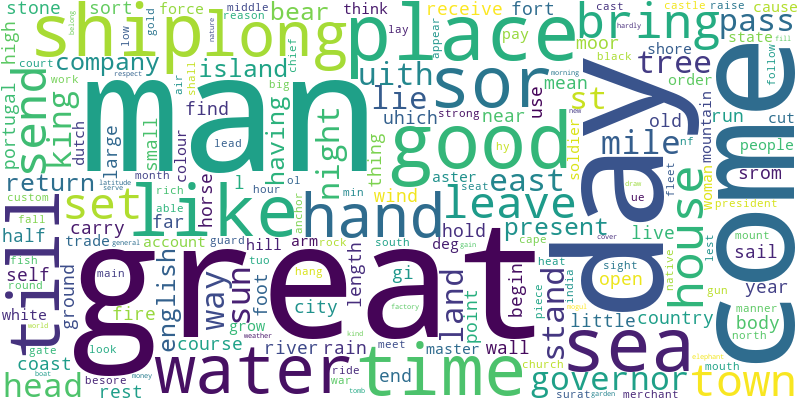
Digital analysis reinforces these impressions. Word frequency highlights Fryer’s dual focus: nautical terms such as sea, ship, course, wind sit alongside bodily and natural references like man, hand, tree, horse, blood. This blend demonstrates his attempt to integrate maritime travel with the observational practices of a physician and natural historian. Sentiment analysis shows a slightly positive overall tone (+0.08), with spikes of enthusiasm when describing abundance (“the best Indico in all India,” “a comely well Limb’d Person”) and sharp negativity when encountering poverty or filth (“every Door a Dungill”). The polarity of sentiment underscores the interplay of admiration and censure that runs throughout the narrative.
Taken together, Fryer’s New Account illustrates a transitional phase in travel writing. It reflects the pragmatic concerns of the East India Company while also embodying the rationalist and empirical spirit that would characterise the Enlightenment. Fryer was neither a diplomat negotiating prestige nor a merchant tabulating profit, but a physician cataloguing the world through the lenses of medicine, science, and observation. His account provides a window into the evolving function of the traveller, as not only a representative of crown or company, but also a proto scientist seeking to interpret, classify, and ultimately master the unfamiliar world.