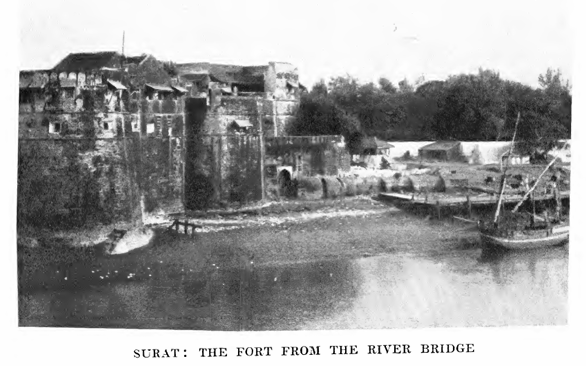
John Ovington’s A Voyage to Surat in the Year 1689 (ed. H.G. Rawlinson, Oxford, 1929) is a hybrid text that combines the nautical detail of a ship’s log with the moral and religious reflections of an English clergyman. His journey began on April 11, 1689, aboard the ship Benjamin, which was not only tasked with commerce but also with political symbolism: it served as an “Advice-Ship” announcing the accession of William and Mary to the English throne. This mission of trade and political news gave Ovington’s voyage a dual purpose and framed the narrative as part of England’s emerging global power.
The structure of the text is chronological; yet unlike Peter Mundy’s terse log, Ovington’s writing is expansive, analytical, and moralizing. His voice is that of an educated observer who blends practical nautical notes with philosophical judgments. Like Fryer, he pays attention to health on board, describing “distempers” such as scurvy and advocating oranges and limes as remedies. But he also turns repeatedly to moral critique, castigating the inhabitants of Madeira for “Effeminate Lewdness” or censuring the “licentious” behaviour of local populations. His prose is filled with classical allusions and rhetorical flourishes, marking him out as a learned commentator rather than a mere recorder of facts.
Thematically, Ovington ranges widely. He acknowledges the wealth of India but devotes much space to its political and social structures. His depiction of Aurangzeb emphasises cruelty, succession by force, and the fragility of Mughal authority, with frequent references to rebellious “Rajahs.” He also contrasts the servility of Indian courtiers with what he perceives as the relative freedom of the Chinese, using these comparisons to underscore English values of honour and independence. Religion occupies a central place: Ovington describes Bannians and Parsis in detail, evaluates their customs, and critiques their practices through a Protestant lens. Anecdotes, such as the English sailor who refused to bow before the King of Siam, serve to dramatize English moral superiority in contrast to “barbarous” Eastern customs.
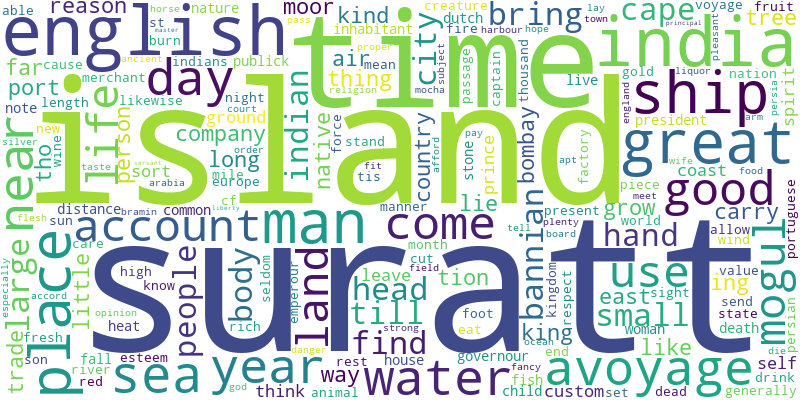
Digital analysis supports this dual emphasis. Word frequency highlights the interplay of geography (suratt, india, island, cape), nautical terms (ship, sea, voyage, water), and moral-religious vocabulary (bannian, mogul, church, faith, religion). This distribution reflects Ovington’s attempt to document both the physical journey and the moral world he encounters. Sentiment analysis shows a slightly positive overall tone (+0.08), but with strong fluctuations: praise for abundance and natural wealth (“the best Fruits and Wines…variety of Excellent Pulse and Roots”) alternates with scathing judgments of immorality, instability, and “miserable” customs. This oscillation mirrors Ovington’s dual role as a recorder of facts and a preacher of morals.
Ovington’s Voyage thus marks an important development in English travel writing. It integrates the navigational precision of Mundy, the medical and scientific concerns of Fryer, and the political awareness of Roe, but reframes them within a religious and moral narrative. In doing so, it anticipates the Protestant missionary discourse that would become increasingly influential in the eighteenth century. His text portrays India as a land of immense wealth and power, yet simultaneously as a place of corruption, cruelty, and religious error — a vision that reinforced English cultural and spiritual superiority.