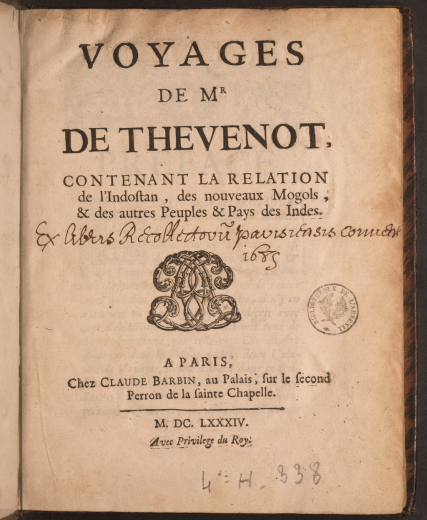
Jean de Thévenot’s Voyages contenant la relation de l’Indostan, des nouveaux Mogols et des autres peuples et pays des Indes (1684) provides one of the richest French accounts of seventeenth-century India, combining meticulous description with a distinctly European interpretive lens. His journey began with a departure from Basra on November 6, 1665, and culminated in his arrival at Surat on January 10, 1666. Unlike merchants such as François Martin or Pyrard de Laval, Thévenot travelled as a gentleman observer, and his narrative is structured not as a logbook but as a carefully organized account divided into chapters that deal with specific regions and topics.
The author’s style is methodical and descriptive, offering factual detail about cities, architecture, trade, and customs. His voice is that of a curious European, often comparing what he sees with familiar points of reference e.g. Agra’s streets to those of Paris, or Indian acrobats to rope dancers in France. While largely observational, Thévenot does not refrain from judgment, particularly when condemning what he perceives as “superstitions” or “barbarous” practices. His account therefore oscillates between curiosity and critique, a hallmark of much seventeenth-century French travel literature.
The thematic scope of the text is wide. Thévenot describes economic life in detail, noting the complexity of local currencies (rupies, pechas, abassis) and the thriving trade in Surat, Ahmedabad, and Bengal. He pays close attention to the activities of European trading companies, especially the English and Dutch, situating them within the commercial fabric of Indian cities. Political commentary is equally present: he outlines the genealogy of the Mughal dynasty, discusses the administrative structures of governors and officers, and remarks upon regional tensions such as Sivagy’s raids on Surat and the Mughal-Persian conflict over Candahar. Religion features prominently throughout. Thévenot describes mosques, pagodas, and temples, catalogues the diversity of religious groups: Muslims, Hindus, Banians, Jogues, Parsis and comments extensively on their practices, from cow veneration to cremation rituals. Cultural observations are woven in: clothing, food, animal husbandry, astrology, and entertainment such as acrobatics and juggling.
India emerges in Thévenot’s account as a land of immense wealth and variety but also of contradictions. He marvels at the prosperity of merchants in Surat and the grandeur of Ahmedabad’s gardens and mosques, yet disparages certain foods, customs, and spectacles as crude or irrational. His description of Brahmin dominance over women, particularly in the practice of sati, reflects both fascination and condemnation, and he highlights the Mughal rulers’ relative religious tolerance as a welcome contrast to local “tyrannies.” His notes on customs checks in Surat, where travellers are thoroughly searched, convey a sense of intrusion and critique of local governance.
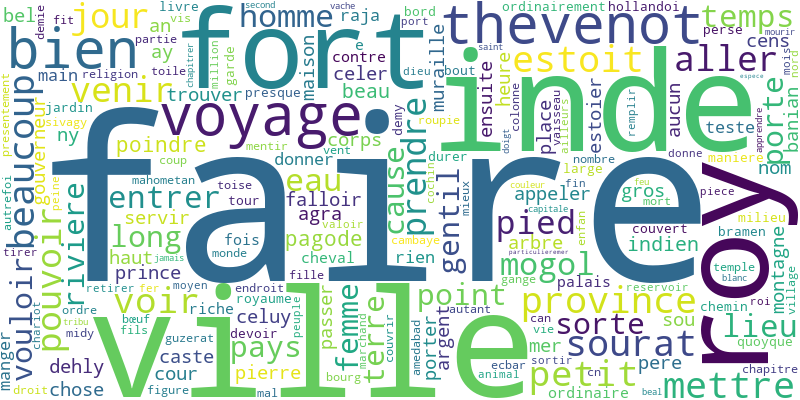
Digital analysis reinforces these themes. Word frequency shows repeated references to geography (Sourat, Agra, Inde, Bengale), political authority (Roy, Mogol), and religious or social groups (Gentil, Banians, Faquirs). Other frequent terms, such as ville, voyage, pagode, pierre, rivière, underscore the importance of spatial, architectural, and religious description. Sentiment analysis indicates a predominantly neutral, factual tone (average score ~0.019), punctuated by positive remarks, for instance, admiration for agricultural abundance or architectural beauty, and sharp disapproval when confronting religious idols or practices he deemed “grotesque.” Thévenot’s Voyages thus occupies an important place in French travel writing. More analytical than Martin’s commercial journal and less immersive than Pyrard’s ethnographic account, his work offers a panoramic survey of India’s political, religious, and cultural life, filtered through a distinctly European lens. It illustrates both the accumulation of empirical knowledge about the subcontinent and the persistence of ethnocentric biases that shaped European interpretations. In doing so, Thévenot contributes to the construction of India’s image in early modern Europe as a land of wonder, wealth, and difference—both admired and judged through the eyes of the traveller.