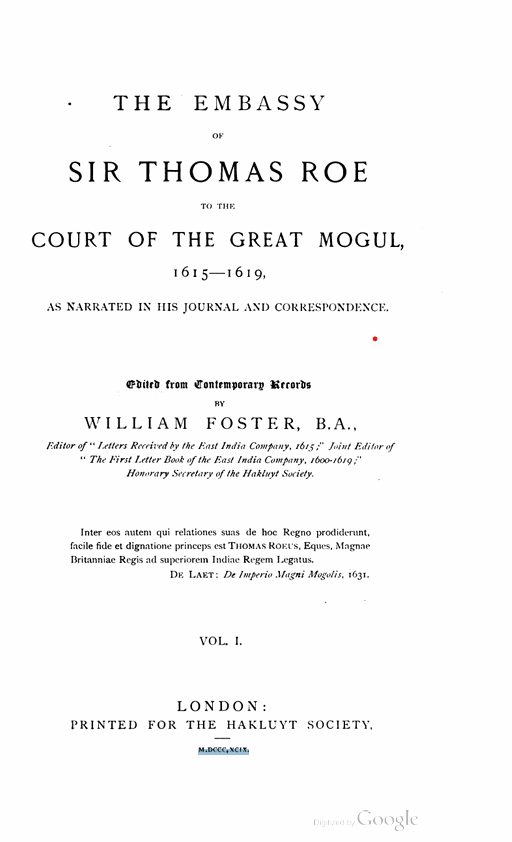
Thomas Roe’s journal remains one of the most important documents for understanding early Anglo-Mughal relations in the seventeenth century. Sent by King James I as England’s first official ambassador to the Mughal court, Roe’s mission was explicitly political and commercial: to secure trading privileges for the English East India Company and to establish a permanent foothold in India. His embassy to Jahangir between 1615 and 1619, recorded in his journal and correspondence later published by the Hakluyt Society (Foster, 1899), provides not only a record of diplomatic negotiation but also a window into the ways English envoys perceived and represented India at a crucial moment in the early modern encounter.
Roe’s account is structured as both a practical guide and a diplomatic diary. He begins with navigational observations, offering detailed advice on winds, courses, and latitudes before turning to his experiences in Surat and at Jahangir’s court. The narrative is shaped by two dominant concerns: the logistics of maritime travel and the politics of commerce. Word frequency analysis of his journal underscores this duality: terms such as “king” (496 occurrences), “prince” (309), “trade” (128), and “Suratt” (127) sit alongside navigational vocabulary such as “wynd”, “course”, and “ship.” This quantitative evidence mirrors Roe’s rhetorical strategy: he presents himself as both a man of reason, capable of correcting his pilots’ navigational “errors,” and as a statesman, negotiating with princes and governors to secure English interests.

The thematic core of Roe’s writing is his effort to establish English prestige in a highly competitive political environment. His descriptions of interactions with Mughal officials consistently emphasise reputation, hierarchy, and status. He refuses to submit to customs he deems “barbarous,” insists on being treated as the representative of a sovereign monarch, and repeatedly critiques not only his local hosts but also fellow Europeans whose conduct, he claims, undermines England’s dignity. His criticism of Thomas Coryat, whom he accuses of bringing shame on the English by traveling “in a beggerly and poore fashion,” highlights the symbolic importance of comportment as part of diplomatic practice.
Roe’s text also reveals his deep hostility toward the Portuguese, whom he labels England’s principal “enemyes.” His vocabulary here is telling: the Portuguese are described as “languishing” and “wearing to nothing,” yet he insists they must be “utterly broken” by aggressive action. This mixture of contempt and anxiety reflects broader European rivalries in the Indian Ocean and anticipates the increasingly militarized strategies of the English East India Company in the decades that followed.
Sentiment analysis of the text confirms Roe’s oscillation between frustration and confidence. While the average score across the text is slightly positive (+0.09), his entries alternate between moments of irritation at “vnrulines of the English” or “untruth” of local officials and affirmations of English superiority and divine favour. Positive sentiments cluster around descriptions of the Mughal elite (“He is very affable, and of a cheerefull countenance”) and around Roe’s own diplomatic successes (“Hee replied if I would come oftner to the Prince, he would effect all my busines”). By contrast, negative sentiments are rare but telling, as when Roe laments being “abused in my Carriadges” or foresees “terrible hostilitye by the way of Bagdatt.” The balance of positive over negative sentiment reinforces Roe’s self-presentation as a confident envoy who believes in the ultimate success of his mission, even when beset by obstacles.
What emerges from both close reading and digital analysis is a portrait of a man deeply invested in projecting English rationality, dignity, and permanence. Roe interprets India through a commercial and political lens: it is above all a land of immense wealth and opportunity, albeit one governed by complex and unpredictable power structures. His representations of the Mughal court oscillate between admiration for its grandeur and scepticism of its officials’ integrity, a tension that mirrors England’s tentative but ambitious approach to empire in the early seventeenth century. Ultimately, Roe’s embassy exemplifies a transitional moment in English overseas activity. No longer mere adventurers or merchants, English representatives were now presenting themselves as ambassadors of a sovereign power, demanding recognition and negotiating privileges with one of the world’s great empires. Roe’s journal is therefore not only a diplomatic record but also an ideological text, asserting the legitimacy of England’s claim to a place in the global order. The patterns of language, sentiment, and emphasis in his writing make clear that his mission was as much about constructing English prestige as it was about securing commercial treaties.