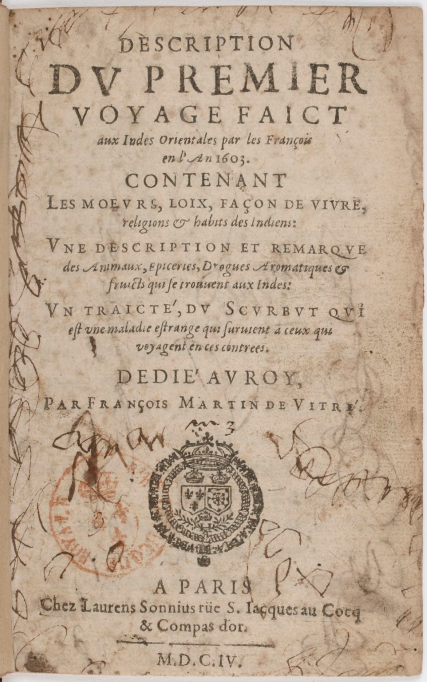
François Martin’s Description du Premier Voyage is among the earliest French travel narratives to Asia, documenting the nation’s first commercial expedition to the East Indies (1601–1603). Written by a merchant, the account combines the structure of a navigational log with the pragmatic concerns of trade, making it a foundational document for understanding France’s initial ventures into global commerce. The voyage, organized by merchants from Saint-Malo, Vitré, and Laval, sought to establish France’s presence in the lucrative Asian markets long dominated by the Portuguese and Dutch.
Martin’s voice is pragmatic and precise, yet also celebratory. He repeatedly highlights the “généreuses entreprises” of his compatriots while lamenting the “le defaut de la nation Françoise” in failing to seize opportunities earlier. His style is technical, filled with nautical data such as degrees, winds, leagues, and coordinates, alongside meticulous references to weights, currencies, and commodities. This mixture of navigational detail and commercial calculation reflects the professional outlook of a merchant keen to secure practical knowledge for future voyages.
Thematically, the narrative revolves around two poles: navigation and commerce. Martin meticulously records winds, currents, and safe harbours, while also listing market conditions, local currencies, and the availability of goods such as cotton cloths, silks, spices, and jewels. He notes the presence of Turks who traded regularly, the organization of markets, and the dangers of piracy and storms. Yet his journal is not limited to technical data: it also contains cultural observations, such as punishments for adultery and the customs of local women. At times, fascination with exotic abundance shines through, as in his description of prized fruits. At other times, deep prejudice emerges, especially in passages portraying some populations as “thieves” or even “cannibals.”
Digital analysis confirms this dual character. The most frequent words (fort, grand, eau, isle, terre, vent, nauire, fruit, marchandz, monnoie) point to the navigational and commercial orientation of the text, while the repetition of grand and fort suggests a rhetoric of magnitude, underscoring both dangers and riches. Sentiment analysis reveals a largely neutral tone (average score ~0.03), but with sharp oscillations: positive sentiment when describing fruits or commodities, and negative sentiment when condemning social or religious practices, such as the beliefs of Brahmins. This alternation mirrors the text’s ambivalent perspective – pragmatic admiration mixed with moral disdain.

Compared with English contemporaries like Roe or Mundy, Martin’s account is notable for its purely mercantile perspective. It lacks the diplomatic ambitions of Roe, the technical precision of Mundy’s sailor’s log, or the scientific curiosity of Fryer. Instead, it embodies a merchant’s mindset, concerned above all with profit, navigation, and survival. His biases, however, reveal the same ethnocentric tendencies common to European travel writing of the period, framing unfamiliar practices as barbarous or immoral. Martin’s Description du Premier Voyage thus occupies a unique position in seventeenth-century travel writing. It inaugurates the French presence in Asia not as an imperial project, but as a commercial experiment—tentative, pragmatic, and opportunistic. It is at once a manual for merchants, a celebration of French enterprise, and a testimony to the precarious beginnings of France’s engagement with the global economy.