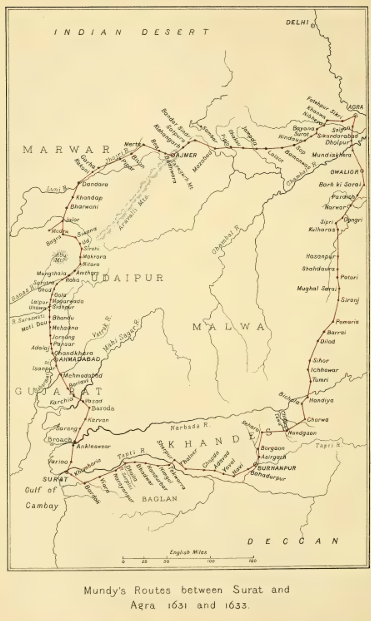
Peter Mundy’s account stands apart from the more politically charged or ambassadorial narratives that of Roe’s. Where Roe framed his mission in terms of diplomacy and prestige, Mundy’s journal is a meticulous and largely impersonal record of a commercial voyage. Written as part of his service for the English East India Company, his narrative is functional and empirical, reflecting the priorities of a merchant and seafarer rather than a courtly envoy.
The edition used for this research is volume two of The Travels of Peter Mundy in Europe and Asia, 1608–1667, published by the Hakluyt Society in 1914 and edited by Richard Carnac Temple. Unlike volume one, which covers his journeys in Europe and the Ottoman Empire, this volume recounts his voyage to India aboard the Expedition in 1628, along with his movements within the subcontinent.
Mundy’s style is striking in its technical precision. He himself calls his work an “abstract of the Marriners Accompte,” and indeed his journal reads more like a logbook than a narrative. The day-by-day structure foregrounds nautical detail: wind directions, miles sailed, latitudes and longitudes, descriptions of coastlines, and notes on supply stops. This is confirmed by word frequency analysis, where terms like course (352), mile (181), river (176), and account (122) dominate alongside expected references to Suratt (206), company (179), and factory (178). These clusters reveal the mercantile orientation of his text: navigation and trade form the skeleton around which the narrative is built.
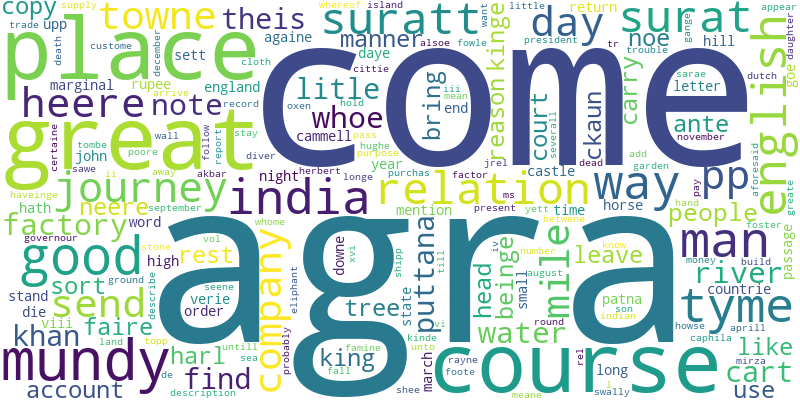
Commercial concerns pervade even his ethnographic observations. When describing Madagascar or Mohilla, his interest quickly shifts from the physical appearance of the people to the practicalities of exchange: what goods they are willing to barter, which items hold value, and whether they are “tractable and sociable” enough to deal with. His descriptions of India are likewise filtered through utility: places are appraised for their commodities (indigo, saltpeter, pintadoes) or their logistical role as stops in the journey between Agra and Surat. The recurrence of words like goods, company, factory, and trade underscores that his gaze was consistently that of a merchant calculating opportunity.
The sentiment profile of the journal is revealing. Overall, the text scores as slightly positive (+0.05), but with far less emotional variation than Roe’s account. Positive sentences often highlight abundance and quality: “This place is nominated to yeild the best,” “Here is made the best Indico in all India”. While negative sentiments appear in connection with famine, poor conditions, or unreliable local collaborators. This pattern confirms the impression of a pragmatic observer: value is measured in material terms, and judgments are tied directly to economic utility. Unlike Roe, whose frustrations and pride saturate his prose, Mundy maintains a tone of detached practicality.
If Roe’s text embodies the language of diplomacy and rivalry, Mundy’s illustrates the logistical backbone of empire. His journal shows the importance of systematic record-keeping in enabling the East India Company’s operations. By standardizing observations of winds, distances, and trading practices, he contributed to the accumulation of navigational and commercial knowledge that underpinned England’s growing dominance in Asian trade. The absence of philosophical speculation or ethnographic curiosity is itself significant: it reflects a new type of travel writing in which the priority is not wonder or persuasion but accuracy, reliability, and commercial intelligence.
Mundy’s Travels thus represent a different face of the same imperial project. Where Roe sought to secure privileges through prestige and diplomacy, Mundy provided the factual scaffolding that made such privileges profitable. His neutral tone, his obsession with data, and his relentless attention to detail show how the East India Company was not only a trading venture but also an information-gathering machine. The combination of close reading and digital analysis makes clear that his contribution was to transform travel writing into a technical instrument of global commerce, offering a vivid window into the mechanics of empire at the ground (and sea) level.