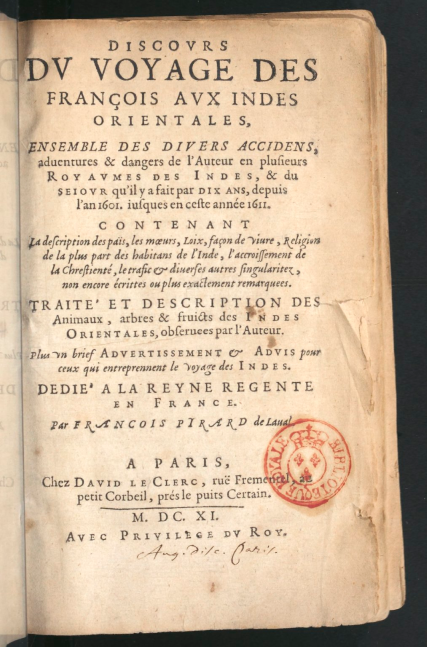
François Pyrard de Laval’s Discours du Voyage des François aux Indes Orientales is one of the most remarkable French travel narratives of the seventeenth century, distinguished by both the length of the author’s stay in Asia and the richness of his observations. Initially a merchant voyage, his journey became an odyssey of more than ten years after the ship Corbin was wrecked in the Maldives. This prolonged captivity allowed Pyrard to acquire a deep familiarity with local customs and ways of life, which he claims to know “more particularly… than any Frenchman, or even Portuguese or Fleming.”
Unlike the concise commercial focus of François Martin, Pyrard’s narrative is expansive, methodical, and explicitly ethnographic. Written as a journal but extending well beyond nautical data, the text covers navigation, natural history, and detailed anthropological descriptions. His account moves from maritime observations and descriptions of ports such as Goa and Cochin to extended chapters on flora, fauna, religious practices, and political structures. Entire sections are devoted to practical aspects of everyday life, such as the uses of the coconut palm, eating habits, and funeral rites, reflecting the perspective of an observer intent on cataloguing the singularities of the Indies.
The central themes of the text are survival, ethnography, and cultural encounter. Pyrard describes the political and religious systems of the Maldives, Bengal, and Kerala, often with both fascination and disapproval. He admires the Nayres as formidable warriors, “les meilleurs soldats du monde,” but judges their customs such as semi-nudity or ritual practices with clear European superiority. Similarly, he notes with horror the worship of “hideous and horrible” idols, which he equates with devil-worship, and describes purification rituals with cow urine as shocking. His voice oscillates between the personal, when recounting his “miseries” in captivity, and the instructive, offering advice for future travellers on how to avoid dangers.
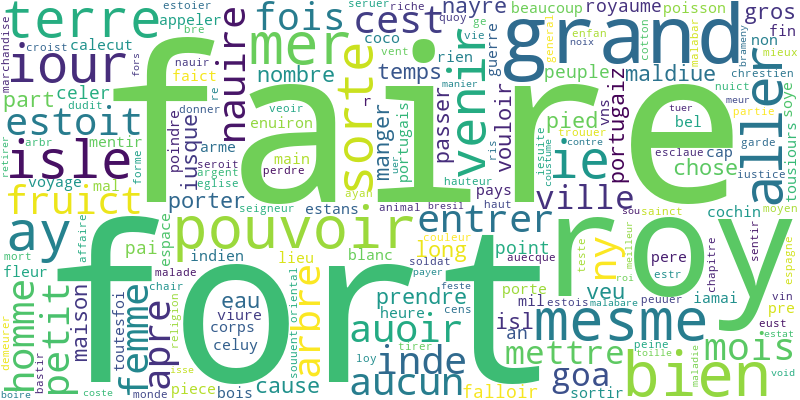
Digital analysis highlights this dual orientation. The most frequent words (fort, faire, roy, grand, mer, terre, isle, fruict, arbre, nayre) show the coexistence of nautical vocabulary and descriptive ethnographic language. The recurrence of fruict, arbre, eau, homme, femme indicates the strong focus on daily life, natural history, and anthropology, setting Pyrard apart from more strictly commercial accounts. Sentiment analysis reveals a predominantly neutral tone (average score ~0.02), but with occasional positive passages celebrating natural abundance, such as detailed descriptions of exotic fruits, and negative ones condemning judicial punishments or religious practices. This fluctuation reflects the text’s blend of curiosity, resilience, and cultural judgment.
Compared with other French accounts, Pyrard’s Discours is unique in scope and ambition. While Martin represents a mercantile perspective and Carré or Thevenot later adopt more political and philosophical tones, Pyrard emerges as a proto-ethnographer, systematically documenting societies with an attention to daily practices and beliefs. His account not only enriches knowledge of India and the wider Indian Ocean but also illustrates the evolution of the travelogue from a commercial log to a form of scientific and cultural inquiry.