– François de La Boullaye Le Gouz
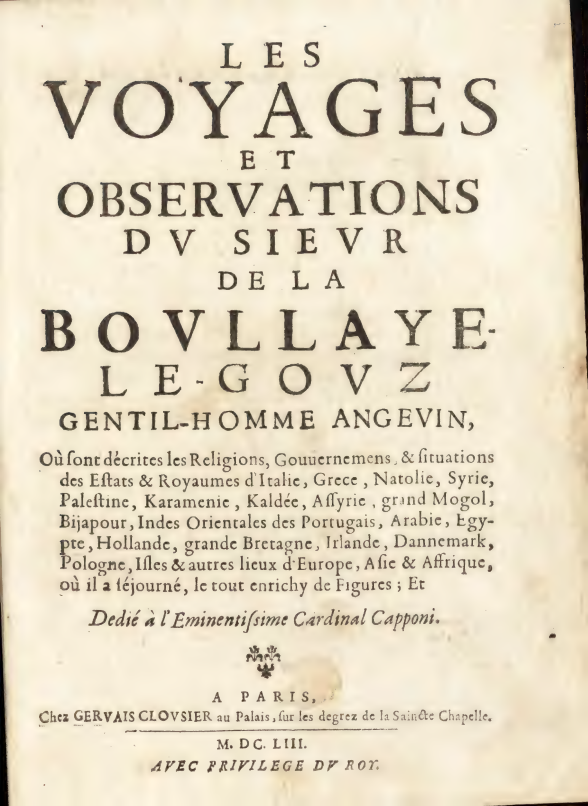
François de La Boullaye Le Gouz’s Les voyages et observations du Sieur de La Boullaye-Le-Gouz (1653) is an expansive travel narrative that spans Europe, Asia, and Africa, offering one of the most wide-ranging perspectives of the seventeenth century. Written in the first person and structured as a chronological account, the text follows the author’s journeys across numerous regions, with each section organized geographically (e.g., Voyage de Ligorne à Florence, Voyage d’Amasia à Erserum). The style is pragmatic and descriptive, combining lists of towns and distances with commentary on customs, religion, and politics. His voice alternates between detached observation and pointed opinion, especially when discussing religious practices or cultural habits.
The thematic range of the text is broad, encompassing commerce, politics, religion, and culture. La Boullaye devotes considerable attention to economic matters, describing trade goods, markets, and the strategies employed by European and Asian powers. He comments on political structures, comparing the governance of the Ottoman, Persian, and Mughal empires, and highlights their military strengths. Religion is a central theme: he provides detailed accounts of the beliefs and practices of Muslims, Hindus, and various sects, frequently contrasting religious tolerance in India under Shah Jahan with persecution in the Ottoman Empire. Cultural detail is equally prominent, from women’s clothing and vegetarian diets to funerary practices and architectural features such as arched houses designed for heat regulation.
When discussing India, La Boullaye portrays the Mughal Empire as wealthy, powerful, and relatively tolerant. He praises Shah Jahan as “extremely gentle,” allowing multiple faiths to coexist and even employing non-Muslims in military service, an observation that contrasts with his harsher descriptions of Ottoman intolerance. His ethnographic attention extends to Indian social structures, religious practices such as the worship of Ram, Schita, or Herman, and rituals like cremation or the veneration of cows. Yet his European bias is evident: he often labels such practices as “superstitions” or “abuses,” struggling to reconcile religious beliefs with utilitarian concerns. His narrative also highlights the competitive presence of European powers i.e. the Portuguese, English, and Dutch, whose commercial and military rivalries shaped the Indian Ocean world.
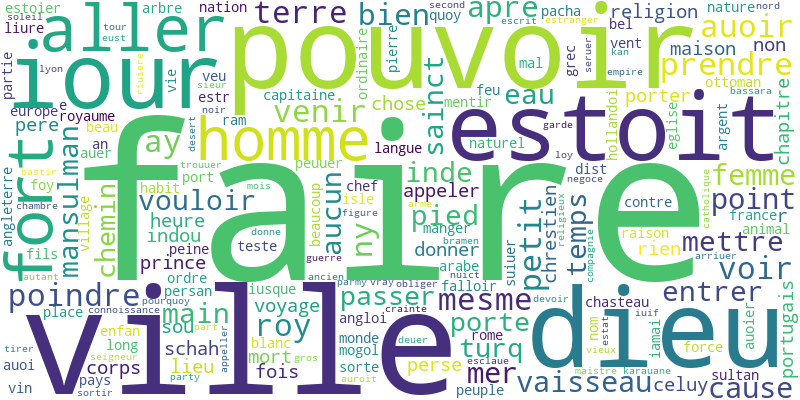
Digital analysis underscores these thematic emphases. The most frequent words (ville, dieu, roy, homme, mer, vaisseau, Inde, mansulman, Indou) show the interplay between geography, religion, and politics. Religious terms such as Dieu, religion, Mansulman, Chrestien and names like Ram and Mahomet are particularly frequent, reflecting the centrality of belief systems in his account. Words tied to travel (chemin, voyage, vaisseau, mer) reinforce the practical nature of the narrative. Sentiment analysis reveals a largely neutral and descriptive tone (average score ~0.03), with occasional positive moments of admiration, for example, praising certain fruits or religious devotion, and negative passages marked by disdain for practices he considered cruel or irrational.
La Boullaye Le Gouz’s travelogue contributes a distinctive voice to seventeenth-century travel writing. Unlike the narrowly commercial account of Martin or the deeply immersive ethnography of Pyrard, his text combines economic, political, and cultural perspectives within a single panoramic vision of the world. His depictions of India reveal both curiosity and prejudice, mirroring broader European attitudes that oscillated between fascination with wealth and exotic customs and a conviction of European superiority.
This work thus illustrates the evolving function of travel literature as a tool of knowledge production, blending empirical observation with cultural critique. La Boullaye’s narrative stands as both a historical record of global interconnectedness and a reflection of the intellectual frameworks through which Europeans sought to interpret and judge the wider world.