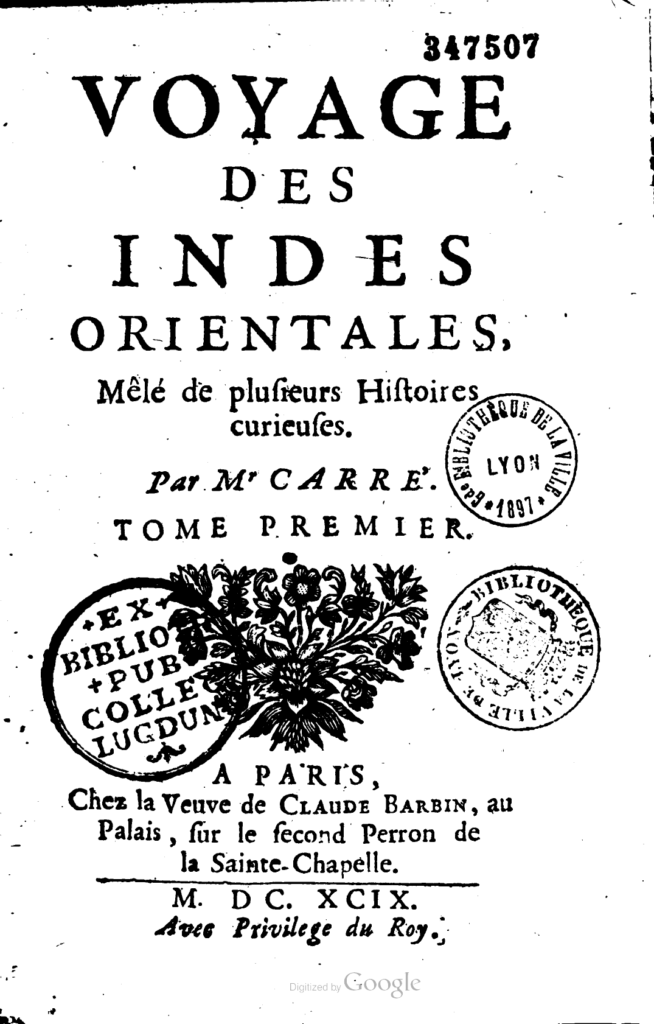
Abbé Carré’s Voyage des Indes orientales (1699) stands out among seventeenth-century French travel accounts for its self-conscious stance toward the genre itself. Carré, an abbot, frames his narrative as a corrective to the “trivialities” of earlier travellers, explicitly aiming to produce a text that is at once useful, serious, and morally instructive. He declares his intention to write only of things that might “serve to the instruction of men” or at least “please them by the charm of novelty.” This authorial stance already marks his work as more didactic and self-aware than many of his contemporaries.
The context of his journey is tied to the ambitions of the newly founded French East India Company, created by Colbert to secure France a place in the lucrative Asian trade. Carré begins his account with a history of the Company’s early struggles, including its failures in Madagascar, which he attributes to poor advice and misinformed travellers. This pragmatic, commercial framing sets the tone for the rest of his observations.
The text combines personal narration with a strongly analytical voice. Unlike Pyrard de Laval’s immersive ethnography or Thévenot’s panoramic surveys, Carré positions himself as a discerning chronicler who deliberately avoids “frivolous” anecdotes. His style is formal, sometimes severe, but also rich in detail, particularly when describing the natural environment. His depiction of the Isle of Bourbon, with its fertile lands and the melancholic “Oiseau solitaire” that dies when caged, blends natural history with moral reflection. In Surat, he comments on the beauty of houses with porcelain floors and tortoise-shell windows, and he carefully describes the European factories, “so well fortified” and “beautiful,” underscoring the intense competition between nations.
The themes of commerce, politics, and religion dominate the text. Carré regards Surat as the commercial “center of the world,” situating it within the global networks of Portuguese, English, Dutch, and French merchants. He provides background on the destruction of the city by the Portuguese in 1520 and its subsequent rebuilding. He also discusses the broader geopolitical rivalries that shaped European presence in the Indian Ocean. Yet his observations are not purely practical: they are deeply infused with a Christian worldview. Carré frequently interprets landscapes, events, and encounters through biblical references, likening Bourbon to the terrestrial Paradise. Encounters with individuals are framed morally: a kind Arab who aids the French is praised, while “Mahometans” are dismissed as inherently brutal due to their “bad principles.” Stories of Turkish merchants trafficking young girls are used to illustrate barbarity and moral corruption.
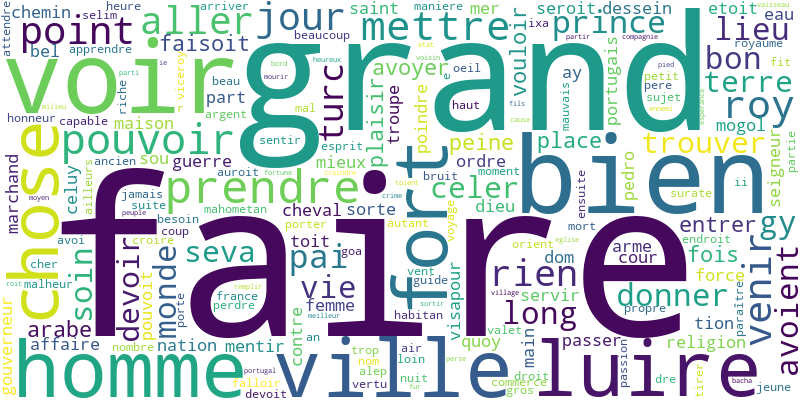
A digital analysis confirms these emphases. Word frequency highlights commerce (commerce, compagnie, marchandises), geography (ville, isle, pays, mer), and moral or evaluative terms (religion, turc, prince, mœurs). Frequent use of evaluative words like grand, bien, fort underscores Carré’s tendency to frame descriptions through judgment. Sentiment analysis shows a largely neutral baseline (average score ~0.026), punctuated by passages of admiration (for natural abundance or loyal Christian allies) and sharp disapproval (for cruelty, “barbarous” practices, or “infidel” behaviour). The oscillation between moral condemnation and admiration for God’s creation reflects the dual lens through which Carré interprets his travels.
Ultimately, Voyage des Indes orientales is a travelogue that aims to transcend its own genre. Carré positions himself not merely as a recorder of experiences but as a teacher, moralist, and advocate for French commercial expansion. His narrative is valuable both for its factual descriptions of places, people, and trade, and for what it reveals about the intellectual and religious mindset of a late seventeenth-century French cleric. It exemplifies the interplay between commerce, religion, and moral judgment that increasingly shaped European views of India.